
It is very common to leave a dermal filler appointment feeling excited, but also a little anxious. You may get home and suddenly wonder what your practitioner advised you to avoid after treatment.
It is completely understandable to feel cautious after dermal filler treatment. It is your face, after all, and you naturally want to protect your result, avoid unnecessary bruising or swelling, and help the area settle as smoothly as possible.
Here are seven things worth paying attention to after filler, along with the reasons behind each.
Note: This guide is designed to help with common aftercare questions after dermal fillers. Your own practitioner’s advice should always come first, especially if you have had treatment in a delicate area, used a particular type of filler, or have any medical concerns.
1. Sleeping directly on the treated area
Sleeping position is one of the biggest worries after filler.
Perhaps you tried to sleep on your back, but woke up on your side. Perhaps you rolled over in the night and are now concerned that the filler may have moved.
First, try not to panic. Accidentally sleeping on your side once after filler does not mean you have ruined your result. Online advice can sometimes make filler migration seem immediate or inevitable, but a single night of poor sleep is unlikely to cause a well-placed filler to suddenly shift.
However, it is still sensible to avoid prolonged or repeated pressure on the area while it is freshly treated. Immediately after injection, freshly placed HA filler can sometimes be gently moulded by the practitioner, and early aftercare often advises avoiding pressure, massage or sleeping directly on the treated area. So it is reasonable to say that prolonged, repeated or uneven pressure may theoretically affect how the area settles, especially in softer or more mobile tissue.
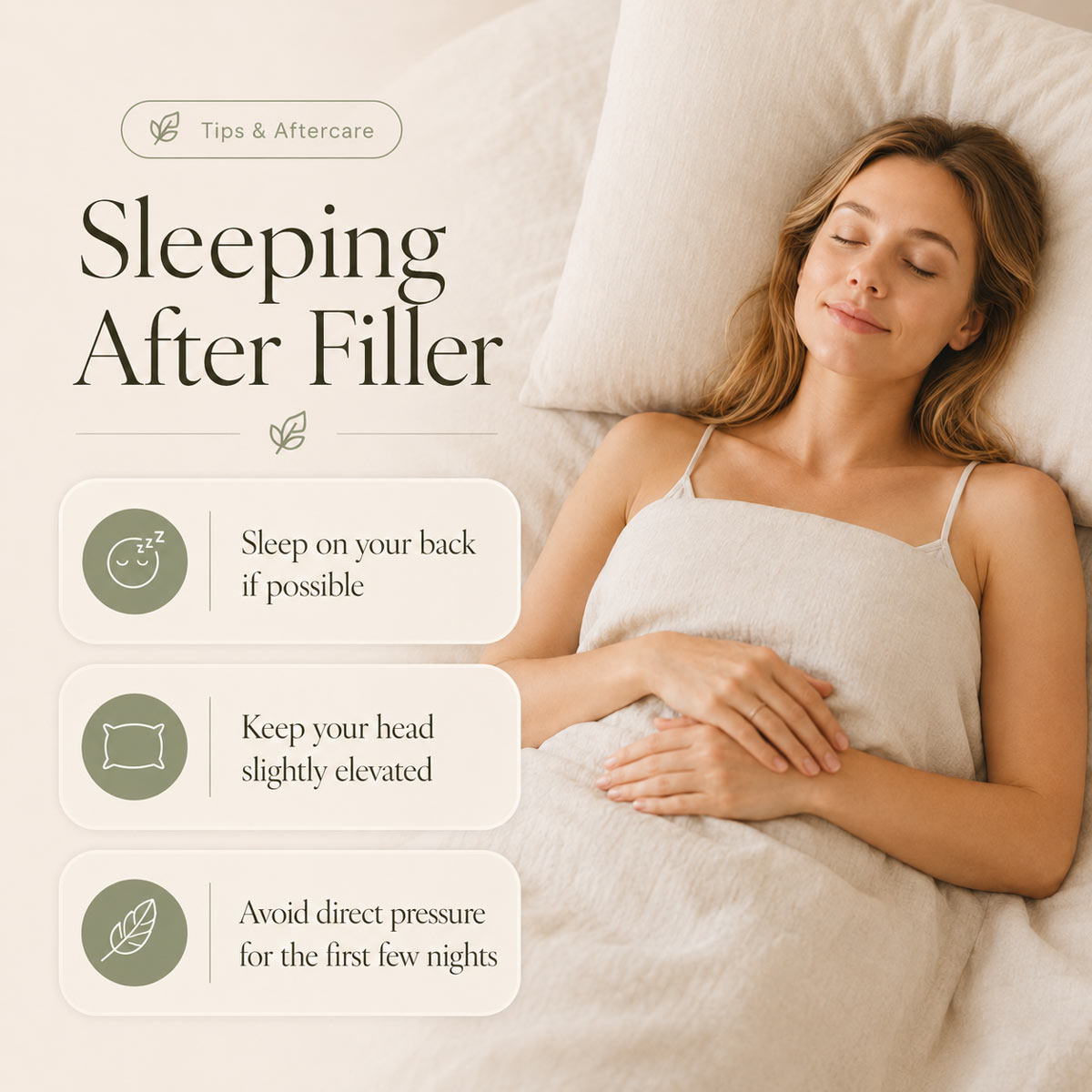
Try to sleep on your back with your head slightly elevated for the first two to three nights, if you can, but do not worry about one imperfect sleep.
This recommendation is mainly to avoid unnecessary swelling, tenderness or irritation. Lying directly on the treated area increases pressure, which can make the area feel more uncomfortable while it settles.
2. Rubbing, pressing or massaging your face
It is tempting to keep checking the area, especially if it feels firm or uneven. You may wonder whether you should massage the area to help the swelling go away faster. Or, if something looks slightly uneven, whether gentle pressure could help move the filler into a better position.
Your practitioner may gently massage, mould or smooth the treated area after the injection. That is different from massaging it yourself at home. In clinic, this is done immediately after the filler is placed, in a controlled manner, with clean technique and a clear understanding of where the filler has been placed, which product was used, and what the area should feel like.
Unless your practitioner has specifically told you to massage the area, it is usually best to leave it alone. Repeated pressing, poking or rubbing can irritate the injection sites and increase swelling or bruising.
It is also worth remembering that there are tiny injection points in the skin, even if you can barely see them. Touching the area too much, especially with unwashed hands, may increase the risk of infection.
In the first few days, what feels like a lump may simply be swelling, tenderness or normal settling rather than a problem or misplaced filler. Pressing it repeatedly can make things more inflamed, not less.
Try to resist. Cleanse gently and avoid unnecessary touching. In the first few days, it is harder to tell what is actual filler and what is just puffiness, so that “lump” you keep prodding at might disappear entirely within a few days. Early swelling can be very misleading.
3. Strenuous exercise too soon
A walk around the block is not the same thing as a spin class, a heavy lifting session or a run in the heat. People often worry that any physical activity will make the filler move, get “sweated out”, or affect the final result.
In reality, filler is not sweated out, and gentle movement is not usually the concern. The more realistic issue is that intense exercise raises your heart rate, body temperature and blood flow. This can make swelling, flushing or bruising worse or more noticeable.
Gentle movement is usually fine, but vigorous exercise is different because it places greater demand on the body while the treated area is still settling.
Most practitioners suggest holding off on anything strenuous for at least 24 hours, sometimes longer depending on the area treated, how much filler was used, and your individual aftercare advice.
If you are not sure where the line is for your specific treatment, ask your practitioner rather than guessing.
4. Alcohol – and go easy on the caffeine
The worry with alcohol is usually bruising.
This is a more realistic concern. Alcohol can thin the blood slightly, which may make bruising and swelling more likely around the time of treatment. It can also dehydrate you, which does not help the skin look or feel its best in the days right after filler. Best to skip it for a day or two.
Caffeine is a smaller concern. One coffee won’t affect your results. But if you’re the sort of person who has five espressos and ends up jittery and flushed, that’s not the state you want your face in right after an injectable treatment. Moderate it rather than cut it entirely.
5. Heat & sunbeds, saunas, steam rooms, hot baths
You may have heard that heat will “melt” your filler, dissolve it, or make it disappear faster.
This is an understandable concern. There is some laboratory and review evidence suggesting that hyaluronic acid can degrade with heat and UV exposure. However, there is no clear direct research showing exactly how a normal sauna session or sunbed session affects injected dermal filler in a real patient.
What we know for sure is that exposure to high heat soon after treatment can increase blood flow, flushing, swelling and bruising while the tissue is settling. Sunbeds, saunas, steam rooms, hot tubs, very hot showers and strong direct sun all fall into this category.
For this reason, it is sensible to avoid strong heat for at least the first 24 to 48 hours. Your practitioner may recommend a longer duration depending on your skin, the area treated, and your individual aftercare advice.
Even though there may not be clear evidence, we recommend taking precaution and avoiding unnecessary heat long-term when looking after your filler’s longevity.
What’s more, minimising sunbed use and prolonged sunbathing will benefit your skin. UV exposure is harmful to skin health and contributes to premature skin ageing.
6. Makeup, facials and strong skincare
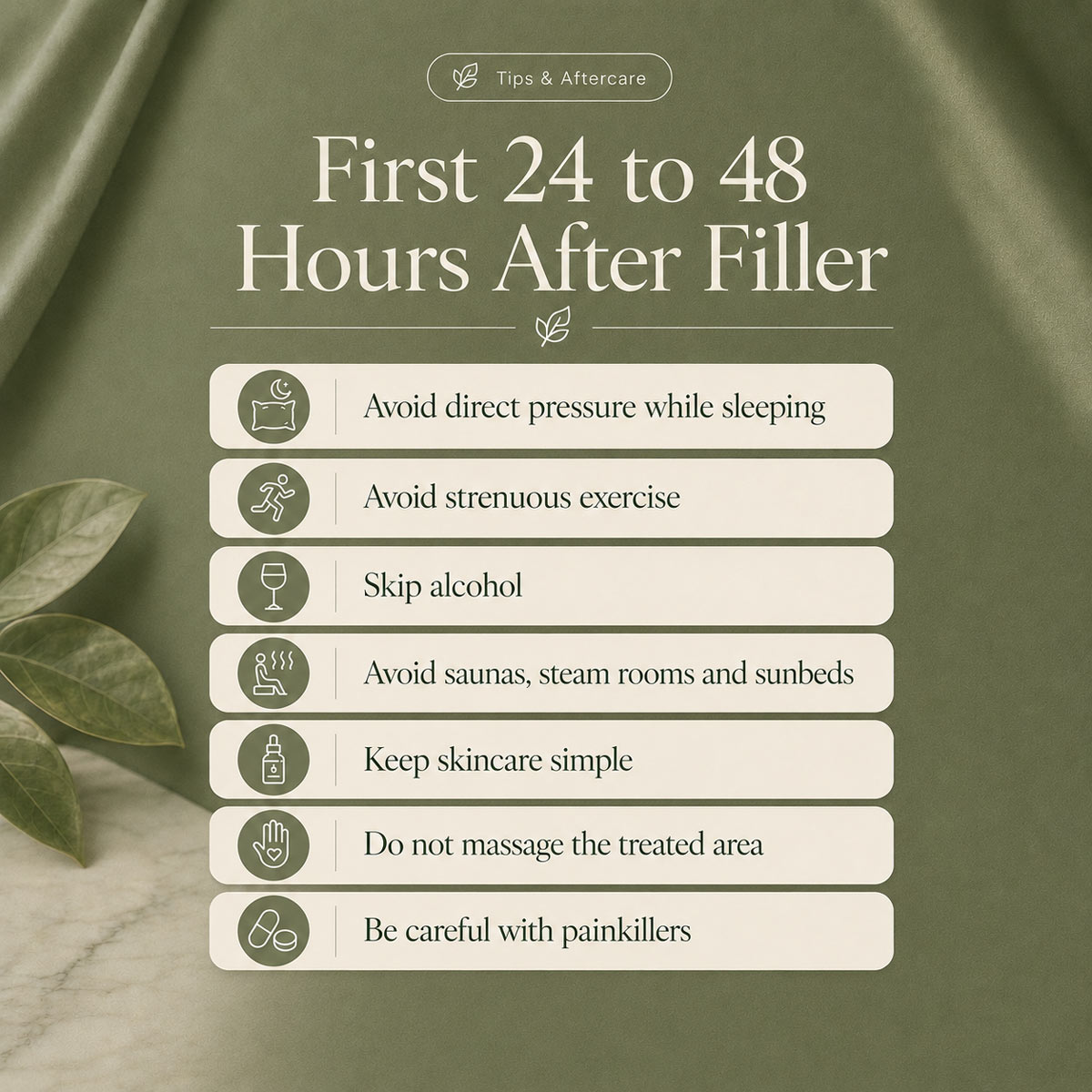
The main concerns here are irritation and infection.
There are tiny injection points across the treated area, even if you can barely see them. That still means the skin barrier has been disrupted, and the area needs to be kept clean while it begins to heal.
Most clinics recommend skipping makeup for a short window after treatment to reduce the risk of irritation or infection. The same goes for exfoliating acids, retinoids, facial massage or any kind of facial – now isn’t the time to try that new peel you’ve been eyeing.
Simple, gentle, minimal is the goal until your practitioner gives the go-ahead to resume your normal routine.
7. Ibuprofen, aspirin or other blood-thinning medication
This one trips people up because reaching for a painkiller is such an automatic reflex when something feels tender.
The main concern is bruising. Ibuprofen and aspirin are generally avoided around filler appointments because they can increase the tendency to bruise. Some supplements may have a similar effect, including fish oil, garlic, ginkgo, ginseng or high-dose vitamin E.
There is an important caveat. Some people take aspirin or other blood-thinning medication for genuine medical reasons, and you should never stop prescribed medication without checking with the doctor who prescribed it.
If you need something for mild discomfort, paracetamol is usually the preferred option, assuming it’s suitable for you. When in doubt, ask your practitioner or GP rather than guessing.
When to actually contact your clinic
At Dr Louise Pierre Aesthetics, we always advise our patients that the results they see in the first few days are not necessarily the final results. Mild swelling, tenderness, bruising or slight unevenness can make the area look different while it settles.
Following the aftercare points above can help reduce unnecessary irritation and bruising, avoid making swelling worse, and support a calmer recovery. For more detail on expected results and settling, see our Dermal fillers treatment page.
But a few things are worth taking seriously. What matters more is anything that gets worse rather than better. Get in touch with your clinic if you notice:
- Pain that’s increasing rather than settling
- Skin that looks pale, dusky, blotchy or unusually discoloured
- Swelling that keeps building instead of gradually improving
- Signs of infection – heat, spreading redness, pus
- Any vision changes or eye pain
- Anything that just feels wrong to you
A good clinic will have given you clear aftercare guidance and a way to reach them if something concerns you.
Previous Posts
Not All Hyaluronic Acid Fillers Are the Same: Why Product Choice Matters
Not All Hyaluronic Acid Fillers Are the Same: Why Product Choice Matters Dermal Filler Insights The hyaluronic acid used in dermal filler treatments is chosen according to [...]
Tear Trough Filler in Streatham: Refresh Tired Eyes at Dr Louise Pierre Aesthetics
Tear Trough Filler in Streatham: Refresh Tired Eyes at Dr Louise Pierre Aesthetics Do your eyes sometimes look tired, even after a full night’s sleep? You’re not alone. Many of us experience under-eye hollows [...]
Get Your Skin Winter-Ready with BioRePeel at our Peacehaven Clinic
Get Your Skin Winter-Ready with BioRePeel at our Peacehaven Clinic As the days get shorter and the temperature drops, our skin often starts to feel dry, tired, and a little lacklustre. Cold winds, [...]