
Not All Hyaluronic Acid Fillers Are the Same: Why Product Choice Matters
Dermal Filler Insights
The hyaluronic acid used in dermal filler treatments is chosen according to the treatment area, the tissue being treated, and the desired result. Although they may seem similar, these gel-like substances can vary considerably in how they behave.
Some are soft and flexible. Some are firmer and more supportive. Some are designed to blend gently into delicate tissue, while others are better suited to deeper structure and definition. This is why the same filler is rarely used across every area of the face. A product that works well in the cheeks may not be right for the lips. A filler chosen for the chin or jawline may be too firm for fine lines or the under-eye area.
Fabric is a good example to use when trying to imagine the difference. Two materials can look similar from a distance, but one may drape softly while another holds a more defined shape.
Fillers behave in a similar way. The right choice depends on what the area needs the product to do.
Understanding this helps explain why a careful, consultation-led approach matters. Natural-looking filler treatment is not only about how much product is used. It is also about choosing a product that suits the area, the tissue and the result being planned.
What makes one HA filler different from another?
Two fillers can look very similar in the syringe, but act quite differently once injected.
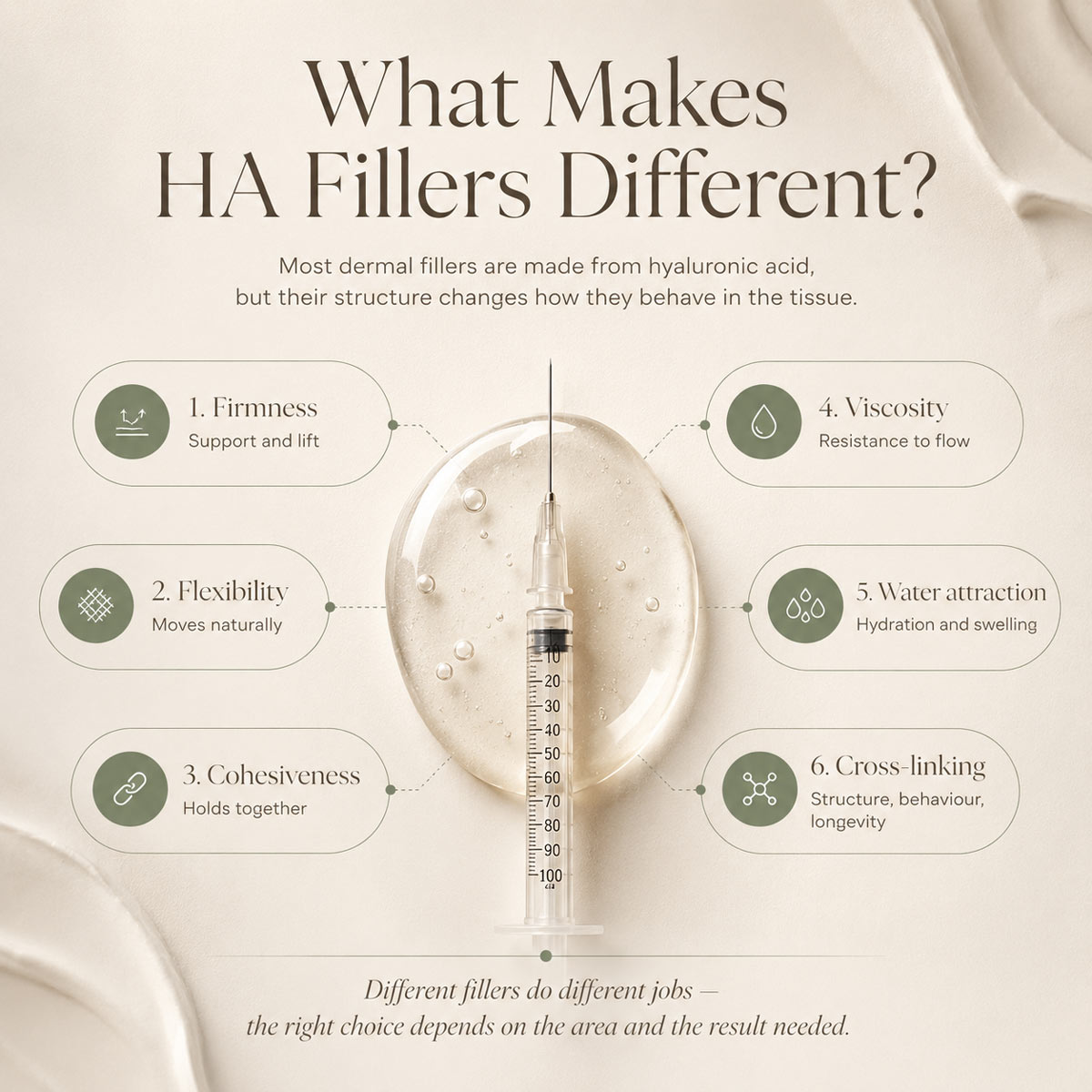
A few key properties:
Firmness: how much support or lift the filler can provide
Flexibility: how naturally it moves with the skin and facial expression
Cohesiveness: how well the gel holds together rather than spreading
Viscosity: how resistant the gel is to movement or flow
Water attraction: how much the filler may soften, swell or hydrate once in the tissue
Cross-linking: how the HA has been modified to affect structure, behaviour and longevity
These properties can also influence how long a filler tends to last. Firmer, more cross-linked fillers generally hold their shape for longer in areas where structure is needed. Softer, more fluid fillers may integrate more gently, but they may not provide the same level of support or longevity.
This does not mean firmer is better. It simply means different products have different jobs.
Why facial tissue changes filler choice
Different areas of the face do not all behave in the same way. Some tissue is soft and mobile. Some areas have thinner skin. Others need deeper support because the concern is linked to volume loss, facial structure or loss of definition.
Soft or mobile tissue
In areas that move frequently, the filler usually needs to be soft, smooth and flexible. These areas may include the lips and the tissue around the mouth, where the filler needs to move naturally with speaking, smiling and facial expression.
A firmer product may give more structure, but it may not always feel or move naturally in softer, more mobile tissue.
Thin or delicate tissue
Some areas have thinner skin or less tissue coverage, which means small irregularities can be more noticeable. In these areas, a practitioner may choose a softer filler, use a very small amount, or decide that filler is not the most suitable option.
The under-eye area is a common example. If puffiness, loose skin or pigmentation is the main concern, filler may not be the right treatment.
Areas needing lift or support
Where the aim is to restore support or improve contour, like cheeks, a firmer filler may be better. This type of product is often chosen when the filler needs to hold its shape rather than simply blend softly into the tissue.
These products may be used more deeply, depending on the treatment plan and the anatomy of the area.
Areas where softening is the goal
Nasolabial folds and marionette lines are slightly different. They are not always treated by simply filling the line directly. Sometimes a small amount of filler may soften the fold itself. In other cases, support in the cheeks, chin or lower face may create a more balanced result.
The filler chosen for these areas is often somewhere between soft and structural, depending on whether the aim is gentle blending, support or both.
How filler depth changes the result
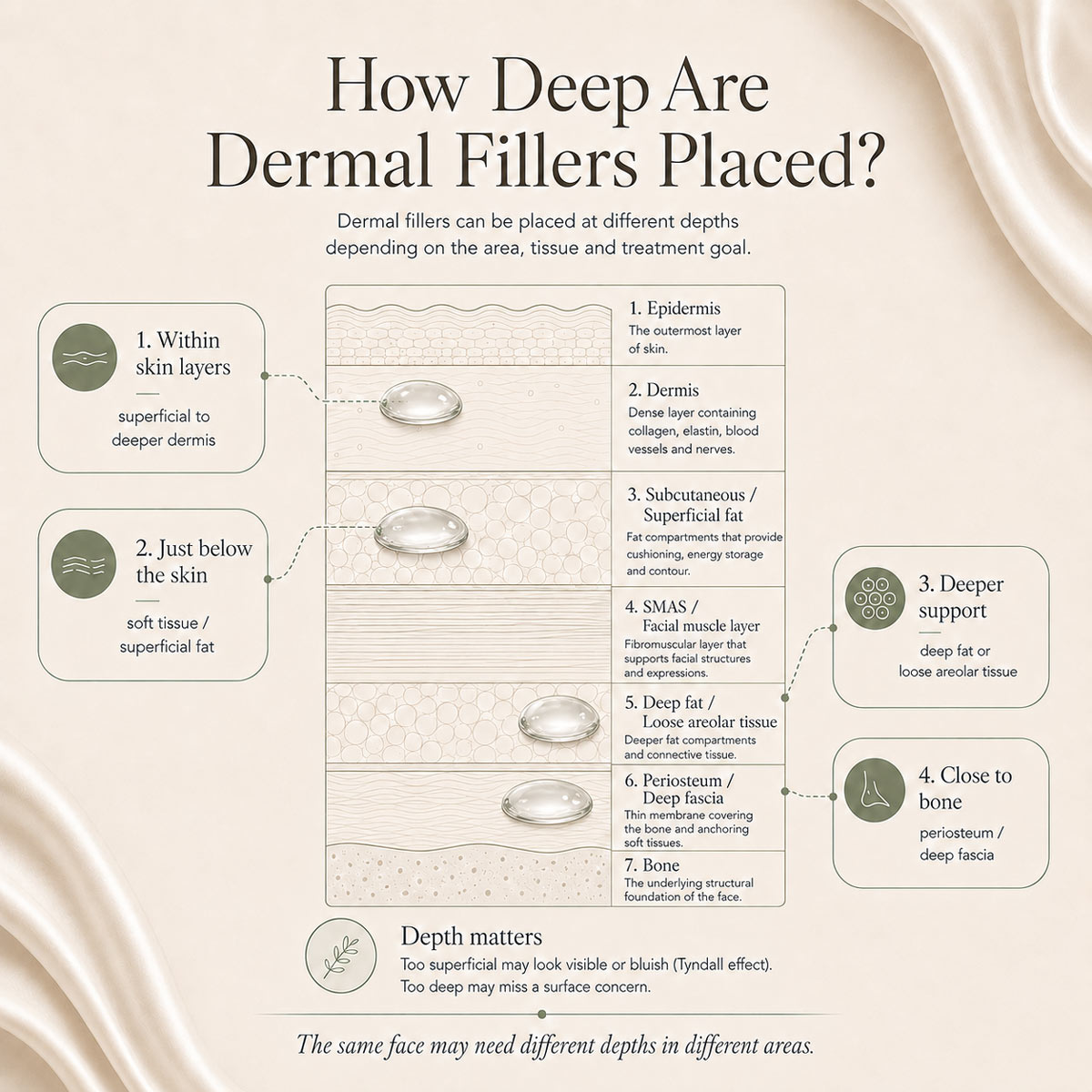
Dermal fillers can be placed at different depths:
Within the superficial or deeper dermis, usually for very fine lines, delicate correction or careful lip border refinement.
In the soft tissue just below the skin, for gentle volume, contouring or blending.
In deeper fat compartments, for facial support and midface restoration.
Close to bone, for structural areas such as the cheeks, chin or jawline.
A filler placed too superficially may become visible, feel uneven or create a bluish tone under the skin, known as the Tyndall effect. On the other hand, a filler placed too deeply may not improve a concern that sits closer to the surface.
Why technique matters
The technique used to place the filler also affects the final result. A practitioner may use either a needle or a cannula. A needle can allow very precise placement, while a cannula is a blunt-ended, flexible tube that may be used for broader areas or softer tissue planes.

Common filler techniques include:
Linear Threading (Retrograde/Anterograde): The filler is deposited in a continuous line as the needle or cannula is slowly withdrawn or pushed forward. It is highly effective for smoothing lines or defining borders.
Bolus (Depot) Injections: A specific, localised amount of filler is placed at a single targeted point, often directly onto the bone, to provide deep structural foundation and lift.
Fanning: Similar to linear threading, but the injector pivots the needle in a fan-shaped pattern from a single entry point to cover a broader area smoothly.
Cross-Hatching: Filler is injected in a criss-cross pattern to form a “lattice” that provides robust structural support and volume to sunken areas.
Microdroplet Technique: Extremely small, individual aliquots (droplets) of filler are placed across the treatment area to subtly improve texture or fine lines.
Why consultation matters before choosing filler
A good consultation is not just about deciding whether to have filler. It is about understanding what is actually causing the concern. A line, hollow or loss of definition may be caused by several changes, including volume loss, skin quality, facial movement, bone structure or tissue laxity.
Sometimes filler is the right treatment. Sometimes another approach may be more suitable. At Dr Louise Pierre Aesthetics, dermal filler treatment begins with an individual, doctor-led consultation. This gives time to assess your face properly, talk through your goals and explain why a particular product, technique or treatment plan may be recommended.
Filler should not be chosen by habit or convenience. It should be chosen for the person in front of the practitioner.
If you would like to understand more about the treatment itself, including what to expect, how long results last and whether it may be suitable for you, read our main guide to dermal filler treatment.
Previous Posts

Accidentally Slept on Your Side After Filler? 7 Things to Avoid After Dermal Fillers
Accidentally Slept on Your Side After Filler? 7 Things to Avoid After Dermal Fillers Dermal Filler Insights It is very common to leave a dermal filler appointment [...]
Not All Hyaluronic Acid Fillers Are the Same: Why Product Choice Matters
Not All Hyaluronic Acid Fillers Are the Same: Why Product Choice Matters Dermal Filler Insights The hyaluronic acid used in dermal filler treatments is chosen according to [...]
Tear Trough Filler in Streatham: Refresh Tired Eyes at Dr Louise Pierre Aesthetics
Tear Trough Filler in Streatham: Refresh Tired Eyes at Dr Louise Pierre Aesthetics Do your eyes sometimes look tired, even after a full night’s sleep? You’re not alone. Many of us experience under-eye hollows [...]